
Short circuit
When everything stops... or worse
What is a short circuit?
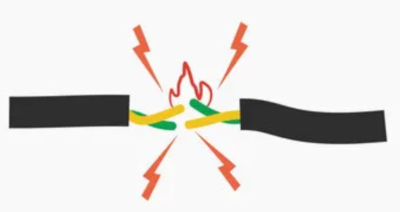
Types of short circuit
Short circuits differ by the number of conductors involved and by how they happen:
- Single-phase (single-pole): the most common in homes and electronics; an accidental connection of one conductor to ground or to another conductor.
- Two-phase (two-pole): two phases connected to each other, or a phase connected to earth.
- Three-phase (three-pole): all three phases connected; the rarest, but it produces the largest current.
- Partial/intermittent: short circuits caused by occasional contact (loose wires, water, moisture).
Effects and problems of a short circuit
When a short circuit happens:
- The current rises suddenly, typically to many times the value allowed for the wires and devices.
- Equipment and wires overheat, so the insulation can burn and cause a fire.
- Fuses or circuit breakers cut off the current to prevent greater damage (if there is any protection).
- In the worst case, the device is completely destroyed, or there is an explosion or a fire.
Symptoms to look out for:
- A sudden loss of power (a tripped fuse)
- Burnt-out parts of the circuit
- A smell of burnt materials
- Overheated conductors or parts
Historical examples of catastrophic short circuits:
• Power station fire in New York (1930): a short circuit caused a huge fire and material damage, and the city was left without power for hours.• Notre-Dame fire (2019): one of the suspected causes of the fire was a fault in the electrical system, where a short circuit played a part in spreading the fire.
Protection against short circuits
Electronic circuits are most often protected against short circuits with fuses, circuit breakers, protective relays and electronic fault-detection circuits. The main job of these components is to monitor the current and, if it suddenly rises (which is typical of a short circuit), to cut off the power automatically to prevent damage to the circuits or a fire. The type of protection depends on what the circuit is for: simpler devices use fuses, while complex systems include sensors, microcontrollers and complex relays that analyse current, voltage and temperature.
Protecting an Arduino from a short circuit on an output pin
Arduino microprocessors (e.g. ATmega328/328P) don’t have physical fuses built into their pins, but there are some internal protections that limit the damage:
- Each digital pin has a recommended maximum output current of about 20 mA, and the absolute maximum is 40 mA (ATmega328P on the Arduino Uno R3). The newer Arduino Uno R4 allows only about 8 mA per pin. If a pin is shorted directly to ground or to the supply without a resistor, the port is overloaded immediately, which can permanently damage the microcontroller.
- The pins have no overload protection at all, neither in hardware nor in software: a program cannot stop too much current from flowing. That is why the real protection is a series resistor (for LEDs 220–330 Ω on the Uno R3 and at least 470 Ω on the Uno R4; larger for other devices).
- The USB port on a computer or an adapter often has its own internal protection that can prevent larger currents and switch off the power in a short circuit, but that is not protection for the Arduino board itself.
Rules for working with Arduino:
• Always use resistors on output pins (especially with LEDs).• Don't connect motors/solenoids that draw a high current directly; use transistors or relays with their own power supply.
• Follow the microcontroller's datasheet for the maximum allowed loads.
A combination of correct wiring and extra external protection (fuses, resistors) keeps an Arduino safe from permanent damage caused by a short circuit or by drawing too much current from its output pins.
 What did we learn?
- A short circuit happens when electric current unexpectedly finds a path of very low resistance, usually because of a fault, damaged insulation or incorrect wiring, and it can then cause a high current, sparks, fires or failures of electronic devices.
- Electronic circuits and Arduino are protected from short circuits by using resistors, fuses, switches, good-quality wiring and correct circuit design.
- Arduino output pins are not protected against overload by themselves, so to drive more power-hungry components (motors, LED strips) we need to use transistors, relays or dedicated drivers.
- In everyday practice it is important to check connections regularly, use suitable protection, not overload circuits and know the basic rules for working safely with electronic components.
- With a smart approach and an understanding of what a short circuit is, you can develop more complex projects with Arduino and enjoy the creativity of electronics – while also taking care of your own safety and the safety of those around you.