
Electricity detectives
Which materials conduct electricity, and which ones stop it?
Which materials conduct electricity, and which ones stop it?
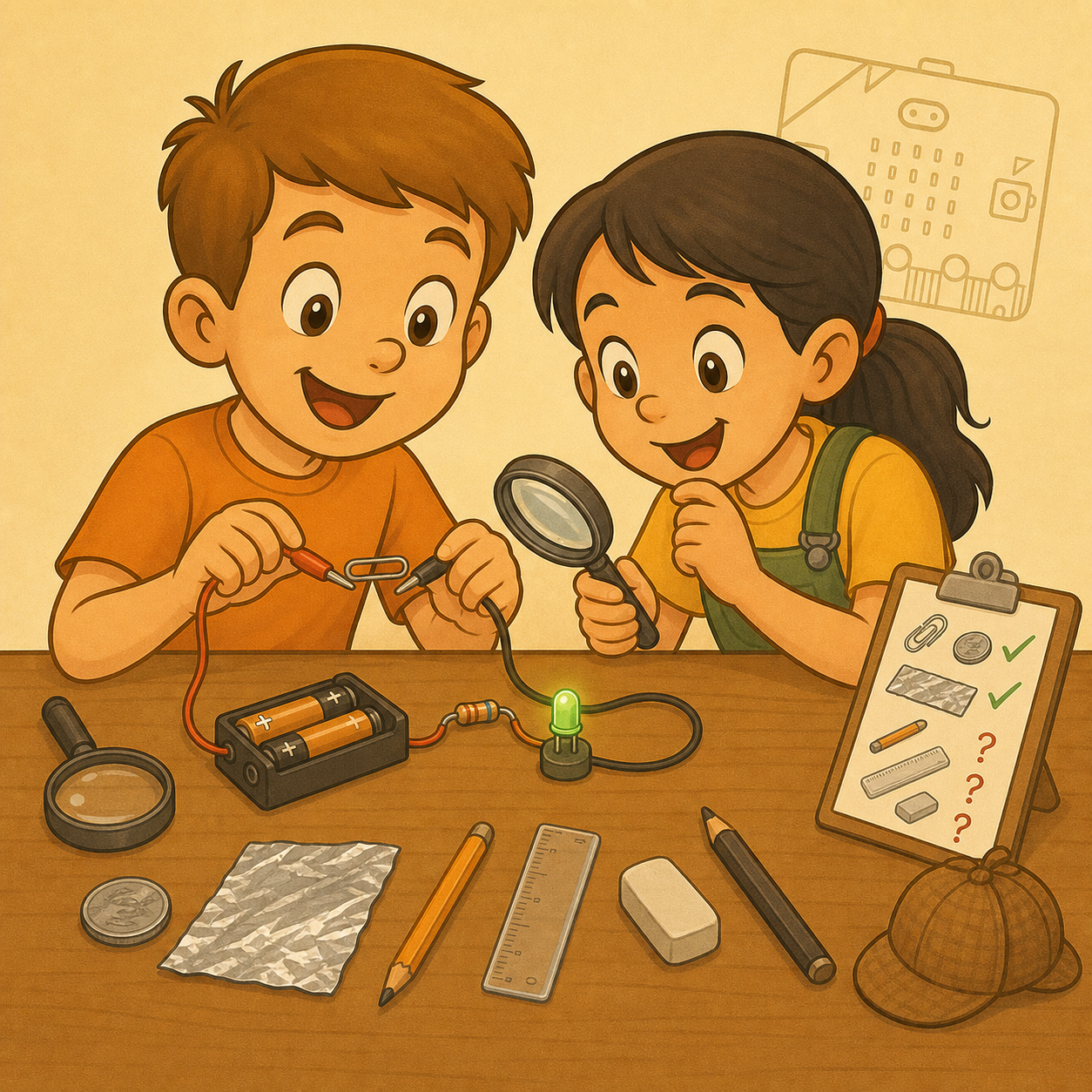
In the last workshop we made our first circuit and lit up an LED. We learnt that the battery gives energy, the wires connect the parts, and the LED only lights up when there is a complete, closed path all the way round the circuit.
Today we are becoming electricity detectives.
We will test different everyday objects and try to find out whether they can help electricity travel. Will the LED light up if we put a coin between two wires? What about a paper clip? A wooden pencil? A piece of plastic? A rubber?
Before we test, we will make a guess first. Then we will do an experiment and check whether we were right.
Our mission
We will make a small conductivity tester.
It is a simple electric circuit that helps us answer the question: Can current flow through this object?
If the object closes our circuit and the LED lights up, the object conducts electricity well enough for our experiment.
If the LED doesn’t light up, the object doesn’t conduct electricity well enough, or it can’t close our circuit.
Important!
We only test the materials the workshop leader has given us. We don't test wall sockets, chargers, cables from the wall, phones, computers or anything connected to mains electricity.Let's remember: what is a circuit?
A circuit is a closed path that electrical energy can travel along from the battery, through the parts of the circuit, and back to the battery.For our tester we need:
- A battery – Gives energy to the circuit
- Wires with crocodile clips – Connect the parts and hold the object we are testing
- A resistor – Helps protect the LED from too much current
- An LED – Shows us whether current is flowing through the circuit
- An object to test – It may or may not close part of the circuit
Our tester looks like this:
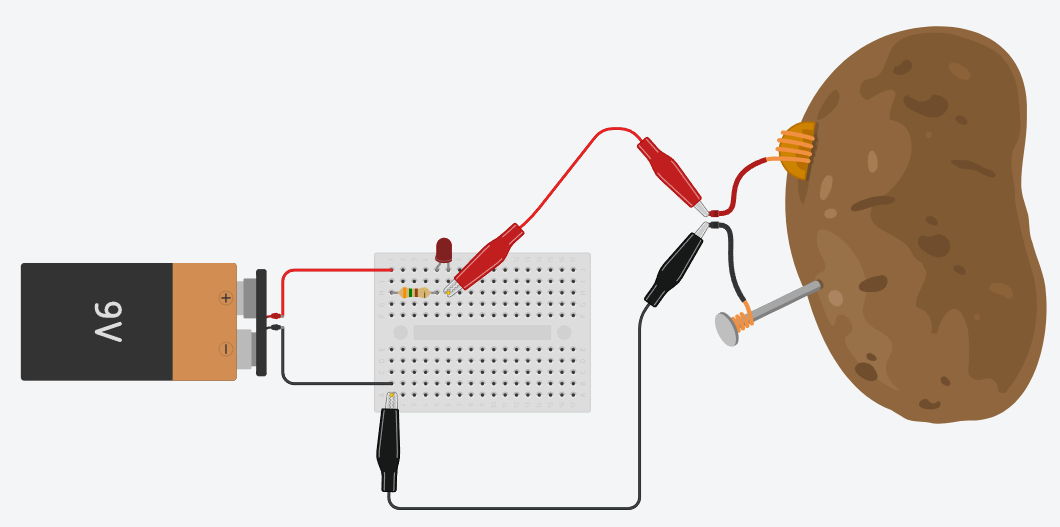
When an object connects the two crocodile clips, it becomes part of the circuit.
If it can let electric current through, the LED can light up.
Conductors and insulators
Materials can behave differently when we try to send an electric current through them.
Conductors
A conductor is a material that electric current can flow through easily.
Many metals are good conductors. That is why wires are often made of metal, usually copper, and then covered in plastic for safety.
Examples of materials that often conduct electricity:
- a metal paper clip,
- a coin,
- a piece of aluminium foil,
- a metal key,
- a metal screw,
- the graphite in a pencil, although it usually conducts less well than metal.
If an object like this connects the two crocodile clips, the LED should light up.
Insulators
An insulator is a material that electric current can’t flow through easily.
Insulators are very useful. The plastic around electrical wires helps keep the current inside the metal part of the wire, instead of letting it reach our hands or other objects.
Examples of materials that usually don’t conduct electricity well enough:
- plastic,
- rubber,
- dry wood,
- paper,
- fabric,
- glass.
If we put a plastic ruler or a rubber between the clips, the LED usually won’t light up.
Remember:
Many metals are conductors, while plastic and rubber are often insulators.Guess first, then test
A real scientist or engineer doesn’t just start at random. First they make a guess, and then they do an experiment to check whether the guess was right.
For each object, follow these steps:
- Guess: Will the LED light up?
- Test: Connect the object between the two crocodile clips.
- Write down or remember the result: Did the LED light up, not light up, or glow more dimly?
- Change the conditions: Swap the crocodile clips round (the polarity). What happened?
- Write down or remember the result: Did the LED light up, not light up, or glow more dimly?
You can use a table like this one:
| Object | My answer before the test | Result of the experiment | My answer before swapping the polarity | Result after swapping the polarity |
|---|---|---|---|---|
| paper clip | Conducts electricity | LED lights up | Conducts electricity | LED lights up |
| … |
Not every result has to be exactly the same. For example, the graphite in a pencil may let a little current through, but the LED may glow more dimly than when we test a metal paper clip.
That is an interesting discovery: some materials aren’t simply yes or no. Some conduct electricity very well, some less well, and some stop it almost completely.
How do we use the tester?
Steps:
- Check that the batteries are in the right way round and that the switch, if there is one, is on.
- Look at the LED: it must be the right way round and connected to the resistor.
- Check the circuit: touch the crocodile clips together and make sure the LED lights up.
- Take the object you want to test.
- Attach one crocodile clip to one end of the object.
- Attach the other crocodile clip to the other end of the same object.
- Look at the LED.
- Write down what happened.
- Disconnect the object and test the next one.
With some objects the clip won’t grip the surface properly. Then, together with the leader, find a spot where you can make a better contact. For example, with foil you often need to fold or press down a little on the part where the clip goes.
What does it mean if the LED lights up?
If the LED lights up, it means the object has helped to close the circuit.
The path of the current can now look like this:
Battery ⇒ wire ⇒ resistor ⇒ LED ⇒ clip ⇒ object ⇒ other clip ⇒ wire ⇒ battery
The object has become part of our circuit.
If the object is a metal paper clip, the LED usually lights up clearly, because metal conducts electricity well.
If we test a material that conducts less well, the LED might not light up or might glow very dimly. That doesn’t have to mean you made a mistake – maybe you have just discovered a material that isn’t a good conductor.
What does it mean if the LED doesn’t light up?
When the LED doesn’t light up, there are two possible reasons:
- The object we are testing doesn’t conduct electricity well enough.
- There is a problem with a connection in our tester.
Before you decide that the object is an insulator, check the tester.
Detective check
Touch the two clips together:
- If the LED lights up with the paper clip, the tester is probably working.
- If the LED doesn’t light up, check the battery, the LED, the wires, the resistor and the crocodile clips.
Now test the object you are interested in again.
If the LED doesn’t light up, that object probably doesn’t conduct well enough.
Good explorers always check their tool first before they make up their minds.
Safety for electricity detectives
Today we only use small batteries and low-voltage circuits. Even so, we always work carefully.
- We never connect the plus and minus of a battery directly with a single wire.
- We don’t touch wall sockets, chargers, wall cables or devices plugged into mains electricity.
- We don’t test objects that are wet.
- We don’t put batteries, wires, clips or other parts in our mouth.
- We don’t take batteries apart and we don’t try to charge them.
- If a battery, a wire or a component starts to get hot, we disconnect the power straight away and call the leader.
- After testing, we switch off the battery holder or disconnect the battery.
Extra challenges
If you have finished the basic tests, try one or more challenges:
- Test both ends of a wooden pencil. Are the results the same on the wood and on the graphite part?
- Fold some aluminium foil into a strip and then scrunch it up. Does the LED behave differently?
- Find an object that has a metal part and a plastic part. Test each part separately.
- Test how important it is for the clips to really touch the metal.
- Draw your tester and label the battery, LED, resistor, wires, clips and the object you are testing.
- Invent a secret switch made of aluminium foil or metal paper clips: the LED only lights up when you connect two metal parts.
Link to the micro:bit
Today the LED shows whether an object can close our circuit.
Later on we will make a smarter version of the tester using the micro:bit. The micro:bit can check whether the circuit is closed and then show a symbol, play a sound or display the result on its LED screen.
That means we will combine two important ideas:
- Materials can conduct electricity or stop it.
- The micro:bit can read what is happening and react according to the program we write.
The micro:bit learning materials use exactly this kind of conductivity investigation as an introduction to working with pins, inputs, conditions, testing and fixing mistakes in a program.
 What did we learn?
- A circuit must be closed for the LED to light up.
- Conductors let current flow through them more easily.
- Many metals are good conductors.
- Insulators make it hard for current to flow, or stop it.
- Plastic, rubber and dry wood are usually insulators.
- Testing starts with a guess and ends with checking the result.
- If something doesn’t work, we check the tester and the connections first.
- We only explore electronics with batteries and safe low-voltage circuits.
Questions to finish
1. What is a conductor?
2. Name two objects or materials that probably conduct electricity well.
3. What is an insulator?
4. Why are electrical wires often covered in plastic?
5. What will probably happen when we put a metal paper clip between the two crocodile clips?
6. Why do we need to check the tester with a metal paper clip before deciding that an object doesn't conduct electricity?
7. Is the graphite in a pencil the same material as the wood around it? How could you check this with the tester?
8. What is the most important safety rule when we work with electricity in the workshop?
9. How could you make a simple switch for an LED out of two metal parts?
10. What could the micro:bit do when it detects that the circuit is closed?