
Drone
From measuring motors and analysing the power supply to the first working drone prototype.
Introduction
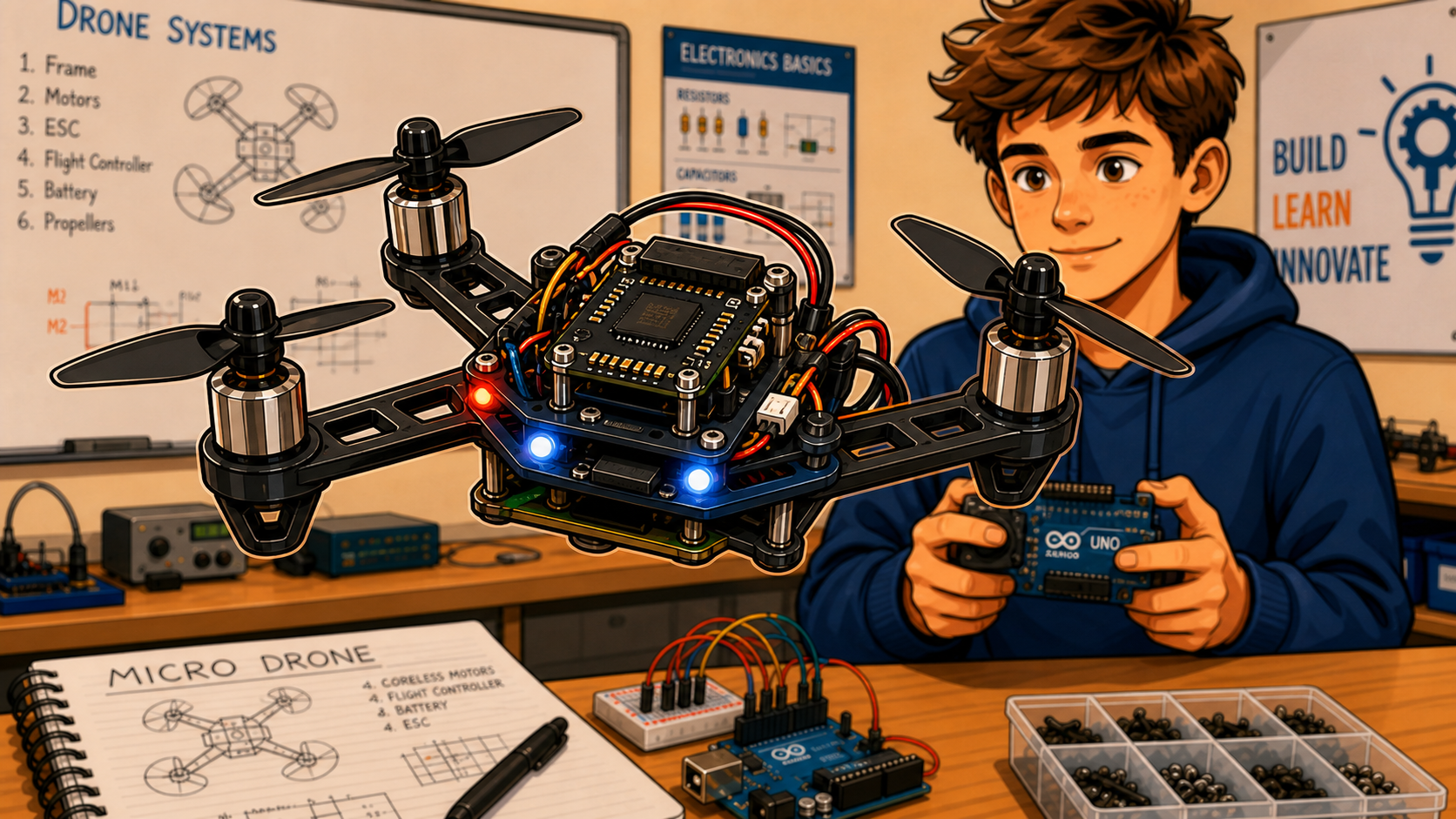
A small drone is not just a fun project, it is also a great way to get to know electronics, programming and the basics of flight through hands-on work. In this project participants investigate how coreless DC motors work, how lift is produced, how to size the power supply and how individual parts are put together into a working mini quadcopter.
The focus of the project is on investigating, measuring and making engineering decisions, not just on assembling a ready-made model. Through the tasks, participants compare the lifting capacity of motors, measure current draw, estimate the mass of the frame and find out what it takes for a drone to be light, stable and safe enough for testing.
There is a special focus on learning through experiments: every motor, propeller, battery and mount affects the final result, so the design is not guessed but checked by measurement and analysis. In this way the project connects physics, design and technology, electronics and Arduino into one whole that shows what developing a real device looks like, from idea to prototype.
Research and analysis
Safety before any experiment
- Propellers: always fix the motor in a holder and wear safety glasses. Keep fingers, hair and cables away from the propeller. Never stop a spinning propeller with your hand.
- Blocked rotor: stop the propeller before switching on, and switch the power on for 1–2 seconds at most. We only do these tests with the workshop leader.
- Power for measurements: use a bench power supply with a current limit, not a LiPo battery. Never raise the voltage above 4.2 V.
- Hot motors: a motor can get very hot after running. Measure its temperature with a thermometer, not with your fingers.
- LiPo batteries: only an adult charges them, with a proper LiPo charger, in a fireproof bag and never unattended. Keep the cell voltage between 3.3 V and 4.2 V. Don't bend, pierce or short-circuit the battery. Hand a swollen or damaged battery to the leader straight away.
Task 1: Get to know the motor and its limits
Goal: Understand the basic parameters of the motor and typical current values.
Research:
- Look up the data for the DC 3.7 V 50000RPM 716 Hollow Cup Coreless Motor.
- Write down the basic dimensions and ratings (diameter, length, voltage, speed).
- Find the no-load current.
- Find the stall (blocked rotor) current and explain why it is dangerous if it happens during operation.
Analyse:
- Calculate the approximate electrical power at no load\[ P = U \times I \]
- Explain the difference in current between running with no load (no-load) and with a blocked rotor (blocked).
- Discuss why a high-speed motor has low torque and what that means for a drone.
Experiment:
- Connect one motor to a power supply (3.7 V) together with an ammeter and a voltmeter.
- Measure the current and voltage:
- without a propeller,
- with a small propeller in the air,
- with a blocked rotor: stop the propeller before switching on, for 1–2 s at most and only with the leader.
- Compare your measurements with the data from the web.
Task 2: Current characteristics of one motor with a propeller
Goal: Find out how much current the motor draws under a real load.
Research:
- Learn what CW/CCW means for the direction of rotation and the shape of the propeller.
Experiment:
- Fix the motor in a holder (3D printed, wood), without a propeller.
- Measure the current at different voltages: 3.0 V, 3.7 V and 4.2 V (set them on a bench power supply with a current limit).
- Measure the motor’s temperature with a thermometer (e.g. a multimeter’s temperature probe) after 30–60 s of running at each voltage and write it down in °C. Don’t touch the motor with your fingers, it can be hot.
- Fit the propeller and repeat the current and temperature measurements.
- Write down how much the current and temperature changed with the propeller compared with no load.
Analyse:
- Calculate the power during typical drone flight (e.g. 3.7 V × measured current).
- Compare how many times larger the current is with the propeller than at no load.
- Think about why the motor must not run at 4.2 V (at full throttle) all the time.
Task 3: Estimating the lift of one motor (thrust test)
Goal: Estimate how much mass one motor with a propeller can lift.
Research:
- Look at examples of mini drones with 7×16 or 7×20 mm motors (micro quads, toys…)
- Notice that drones like these typically have a total mass of around 20 – 40 g.
Experiment 1:
- Build an improvised thrust balance from a motor holder and weights.
- Connect the motor so that the propeller blows downwards and tries to lift itself.
- Gradually add mass until the motor can only just keep the load in the air.
- Measure the mass one motor lifts at different voltages (3.0 V, 3.7 V).
Experiment 2:
- Put the motor holder and the motor on a scale.
- Connect the motor so that the propeller blows downwards and tries to lift itself.
- Measure the mass at rest (use the tables below).
- Measure the mass one motor lifts at different voltages (3.0 V, 3.7 V, 4.2 V).
- Measure the current through the motor at each of these voltages.
- Measure the current through the motor at each of these voltages while the rotor is blocked (1–2 s at most, with the leader).
- Calculate the difference in mass. What does this mass tell us?
- Repeat the experiment for each of the motors you have and compare the results.
| Motor 1 | At rest | 3.0 V | 3.7 V | 4.2 V |
|---|---|---|---|---|
| Mass [g] | ||||
| I [A] | - | |||
| Iblocked [A] | - |
| Motor 2 | At rest | 3.0 V | 3.7 V | 4.2 V |
|---|---|---|---|---|
| Mass [g] | ||||
| I [A] | - | |||
| Iblocked [A] | - |
| Motor 3 | At rest | 3.0 V | 3.7 V | 4.2 V |
|---|---|---|---|---|
| Mass [g] | ||||
| I [A] | - | |||
| Iblocked [A] | - |
| Motor 4 | At rest | 3.0 V | 3.7 V | 4.2 V |
|---|---|---|---|---|
| Mass [g] | ||||
| I [A] | - | |||
| Iblocked [A] | - |
Analyse:
- Write down the mass values you got for one motor.
- Calculate the theoretical maximum lift for four motors: 4 × the lift of one motor.
- Introduce a safety factor: e.g. use only 50 – 60% of that value as the maximum mass of the drone (because you need a reserve for manoeuvring, and the battery gets weaker as it drains).
- Draw a conclusion: e.g. 4 motors can lift at most X g, but for safe flight we aim for a total mass of Y g.
- What are the differences between the motors? Will these differences affect how stable the drone is?
- How can you reduce these differences?
Task 4: Sizing the battery and flight time
Goal: Connect the motor current with choosing a battery and estimating the flight time.
Research:
- Typical LiPo batteries for micro drones: 1S (3.7 V nominal), capacity 150–500 mAh.
- The idea of a LiPo battery’s C rating (how much current it can deliver without overheating).
Analyse:
Take the average current of one motor you found earlier (Task 2) in cruise flight (not full throttle).
Estimate the current for 4 motors:
\[ I_{total} = 4 \times I_{one} \]For the chosen battery (e.g. 300 mAh), estimate the flight time:
\[ effective\ capacity = 70\%\ of\ nominal \]\[ time[h] = 0.7 \times \frac{capacity[Ah]}{I_{total}}. \]Check whether the required current is within the battery’s C rating (e.g. 300 mAh, 20C means a maximum of 6 A).
Experiment:
- Get one battery and measure how many minutes a motor can run at medium throttle until the voltage drops below, say, 3.5 V.
- Compare theory (the calculated time) with practice (the measured time).
Task 5: Electrical design – power supply and protection
Goal: Understand how to protect the motors, the battery and the electronics.
Research:
- Risks: a blocked propeller ⇒ current of up to 1.8 – 2 A per motor.
- Total potential current in a short circuit (4 × 2 A = 8 A + the possibility of a short circuit on the wires).
- Basic protection: a fuse, reverse polarity protection, thick wires for the motors, a low-ESR capacitor close to the battery connector.
Design:
- Decide on:
- the wire cross-section and connectors that can handle the maximum current,
- where to put the fuse,
- the capacitor value (e.g. 100 – 470 µF) at the input to reduce voltage spikes.
- Draw a simple schematic: battery ⇒ fuse ⇒ switch ⇒ distribution to 4 motors + Arduino.
Experiment:
- Simulate one motor being blocked (very briefly, under the mentor’s supervision) and watch how the current rises.
- Check how much the wires and connectors heat up.
Task 6: The frame and the mass of the drone
Goal: The participant connects the mechanical design with the lift of the motors.
Research:
- Examples of small drones (micro quads) and their typical mass (20 – 40 g).
- Frame materials: polystyrene foam, balsa wood, 3D print (PLA), sticks (skewers, straws).
Design task:
Calculate the total mass:
- 4 motors + propellers (known mass),
- frame,
- battery,
- control board (Arduino/flight controller),
- extra electronics (switch, connectors, wires).
The goal is for the total to be well below the maximum lift from Task 3 (e.g. 50 – 60%).
Experiment:
- Build several frame prototypes with different masses and test how they affect the lift (repeat the lift test – thrust test – with the whole drone without the electronics).
Task 7: Motor control and the drive circuit
Goal: Understand how to control brushed coreless motors with an Arduino.
Research:
- The difference between brushless and brushed motors; the 716 motor is a brushed coreless motor.
- Typical H-bridge or MOSFET driver circuits for controlling DC motors with PWM.
Design task:
- Draw a schematic: Arduino PWM pin ⇒ driver (e.g. a transistor + diode or a driver module) ⇒ motor.
- Notice that you need 4 independent PWM channels + 4 drivers (or a ready-made quad motor driver module).
- An Arduino pin must NOT power a motor directly (too much current, inductive spikes).
Experiment:
- Do an experiment with one motor and one driver (e.g. a MOSFET + diode).
- Change the PWM duty cycle and listen/watch how the speed changes.
Task 8: Is this motor good enough for a real drone?
Goal: Take a critical look at the limits of the 716 motor.
Research:
- Compare the 716 with larger 820 coreless motors – larger motors give more power and thrust, with a typical no-load current of around 0.12 A, but with more torque and power.
- Study guides on choosing drone motors and see how KV, size and mass affect lift.
Analyse:
- Based on your measurements, answer:
- What is the maximum mass of the drone?
- Is it enough for the battery + frame + electronics + a minimal payload (e.g. a small LED, a sensor)?
- If not, what would be a better class of motor (e.g. moving to 820 or brushless)?
Discussion:
- Clearly separate:
- An educational project and a demonstration of the principles of flight (the 716 can be fine).
- A stable, working drone with a useful payload (probably needs bigger motors and a more serious flight controller).